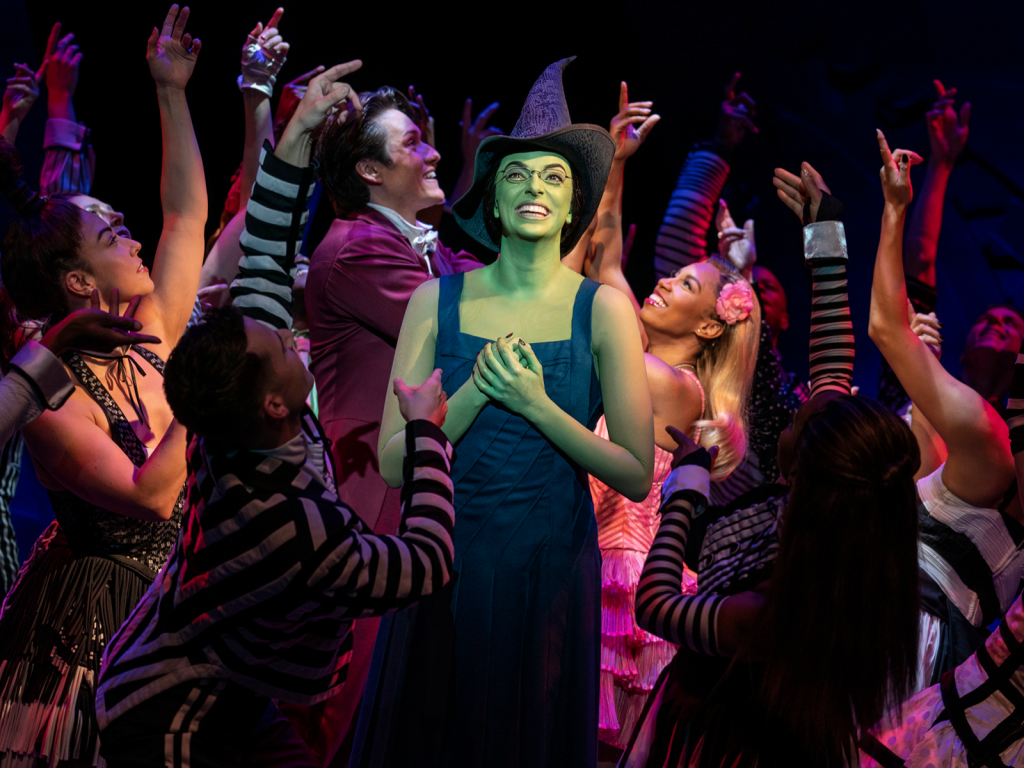
Okay, so, you know how I said I would take the soundtrack chronologically? Let’s not worry about what I said and put that aside for now. Once again, SPOILER WARNING if you haven’t seen Wicked, the musical and the movie!!
I love the Ozdust Ball sequences because of two intertwining pieces of art. First, we have the story – this is sort of a revelatory part of Glinda and Elphaba’s friendship where Glinda realizes the harm she has directly caused while her actions lead Elphaba to begin to understand what trust and friendship can be. Couple that with some beautiful musical sequences, amazing choreography (both the movie and musical nailed Fiyero’s moves), and some musical symbolism, and you get a *chef’s kiss* perfect example of why I love musical theatre.

Let’s break it down. First: Dancing Through Life. Stephen Schwartz does a lot of foreshadowing with the lyrics – “life’s more painless for the brainless” is a literal nod to the future scarecrow himself. In fact, throughout Fiyero’s character arc, we see an interesting evolution of his “brainlessness” from careless and blasé to steadfast and heartfelt. Two different types – the same disdain for logic – but one that only serves himself and the other that he willingly follows in pursuit of Elphaba, his love.
In the middle, during Elphaba’s and Glinda’s conversation (with the pointy hat), you can hear “What is this feeling?” playing in the background. In the movie, it really stands out because you can hear the jumpy chords in the woodwinds that underlie the chorus. Here’s that and the backing track from “What is this feeling?” from the musical so you can compare.
Eventually, we get the melody from “What is this feeling?” but with the lyrics of “Out of the goodness of my heart” – which has the same kind of deceptive playfulness that belies Glinda’s true intentions in the same way she was “loathing” Elphaba in the original song.
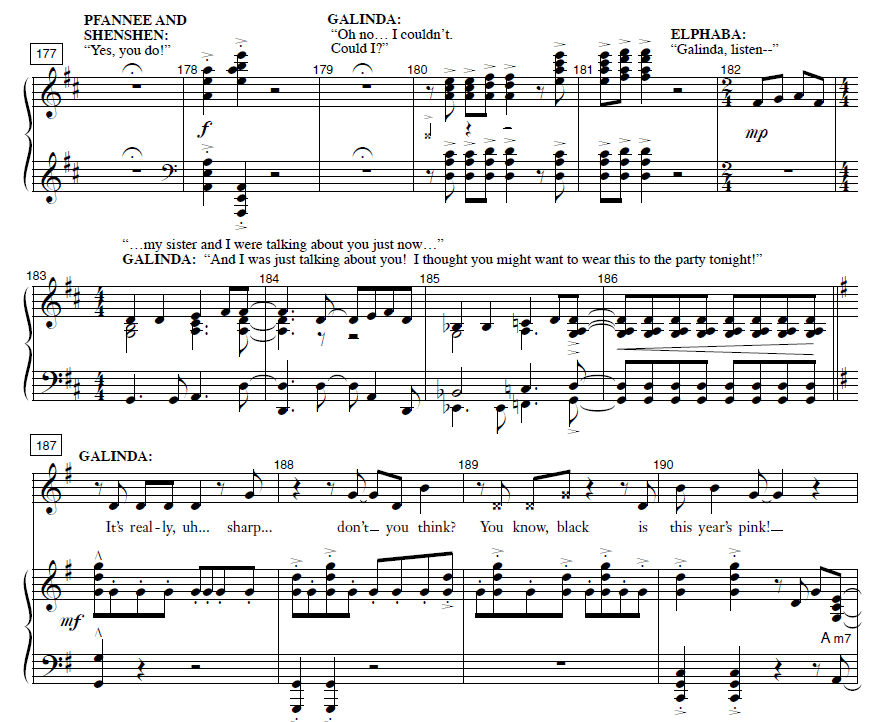

In the middle, during the Ozdust ball, is where I geek out. In the original musical, during Elphaba’s dance, this is the backing that plays:
It’s “Dancing through Life” slowly played in a warm and melancholic tone on the piano – a natural choice for this scene where Elphaba is essentially ostracized and alone. You can possibly make out the “Unlimited” theme in the flutes, but it’s not as natural to me as some of the other times it pops up in the soundtrack. Now, listen to what Schwartz did to the movie version – this is in the “Ozdust Duet” bonus track (I literally cried when I heard this).
Same “Dancing Through Life” but IT’S FOLLOWED BY THE “FOR GOOD” THEME!! He changed it to something with even more meaning to our two protagonists. Given that this moment holds so much value for both Elphaba and Glinda, it seems only natural to insert those beautiful falling major 7th chords into the high piano register. Also, the reverse piano effect is just chillingly gorgeous. Here’s the “For Good” theme, in case you forgot:
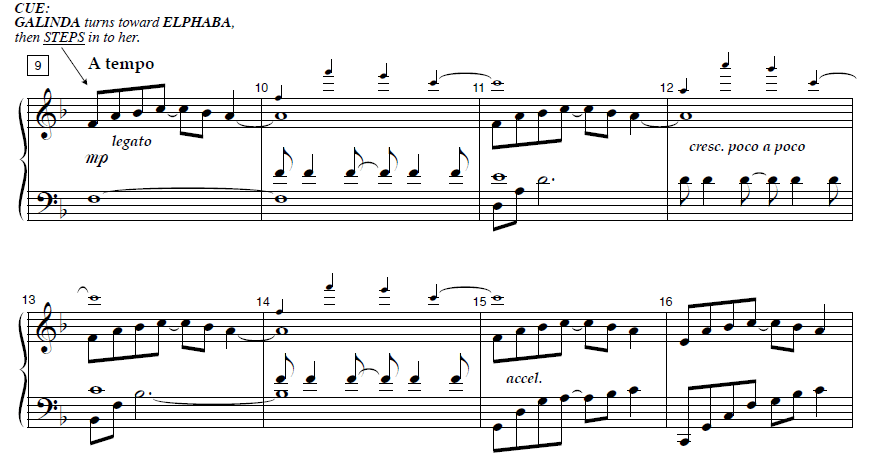
Personally, when I saw this section, I thought that this would be the perfect place to put in that motif, and I guess I was right! It’s a great example of how sometimes, just one little change can transform an entire segment of music and give it even more meaning to the story and characters.
Subtle, but Thematic Scoring
Last thing! In the movie soundtrack, I love that John Powell incorporates the various themes to tell you exactly where (or who) in the story you are! For example, in “The Book Place,” (I also love that that’s the title and not, you know, the library) it begins with a fun little rendition of “Dancing Through Life.”
Then a little bit of “Popular” (I’ll go into more detail of when this shows up in the soundtrack in my next post) which duets nicely with Fiyero’s theme:
Then, finally, a nod to “Dear Old Shiz”:
Just from the soundtrack we know that Fiyero and Glinda are probably somewhere on the Shiz campus (if we didn’t have such an obvious title).
John Powell also hides a couple of themes in “Elphaba at Ozdust.” First, as Elphaba is entering the room (if I remember correctly), the cellos play a solemn “No One Mourns the Wicked.”
In the musical, I loved this theme. In my interpretation, this theme doesn’t necessarily represent evil or wickedness at all. Instead, I think it’s a sort-of manifestation of evil through the ways we treat each other. “No One Mourns the Wicked” not because she was inherently evil (that’s kind of the whole point of the musical), but because she was deemed too different, too powerful, and so she was outcast by society. That, dear readers, is what led to her true wickedness. So in this instance, Powell brings this theme in to show that the true evil in the room, in the Ozdust Ball, are Elphaba’s classmates and peers, looking down on her, laughing at her, pushing her out of society because she is simply different.
One last piece of speculation. This theme keeps coming up in the soundtrack and I can’t find where it’s from! I know that Stephen Schwartz wrote two new original songs for the second movie (“second act”) and I want to think these are actually motifs from those songs, but I guess we’ll just have to wait to find out! If you know what these are from, let me know!!
 Inside my mind: A blog by Michael Imai
Leave a comment